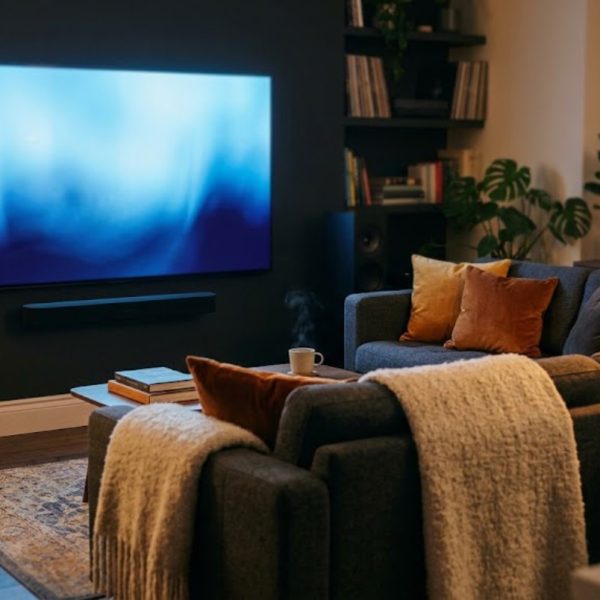
The most expensive home cinema I have ever sat in sounded worse than a decent television. Four figures of speaker per corner, a subwoofer the size of a filing cabinet, and dialogue you had to lean forward to catch. The owner assumed he needed better equipment. What he needed was to move the sofa eighteen inches and turn the subwoofer around.
That is the recurring lesson of home theater setup. Beyond a fairly modest price point, the room and the placement decide almost everything, and the receipt decides almost nothing. It is also good news, because the fixes that matter most tend to be free.
Start With the Seat, Not the Screen
Before anything is mounted, work out where people will actually sit, and be honest about it. A screen sized for a viewer two metres away is uncomfortable for one sitting four metres back, and no calibration fixes that. The usual guidance puts the screen at roughly a third to a half of the viewing distance in width, which for most living rooms lands somewhere between 55 and 75 inches rather than the biggest panel the budget allows.
Height matters as much. Screens mounted above fireplaces look tidy in photographs and force everyone to watch with their necks tilted for two hours. Eye level with the lower third of the picture is the target, even when it means the television sits lower than the decor would prefer.
Where the Sound Actually Goes Wrong
Three placement errors account for most bad-sounding rooms. The centre speaker, which carries the dialogue, is tucked inside a cabinet where the shelf absorbs everything above a certain frequency. The surrounds are behind the seating rather than beside and slightly behind it, so effects arrive from a point nobody occupies. And the subwoofer is jammed into a corner, where room modes turn it into a one-note rumble that is deafening on some scenes and inaudible on others.
The subwoofer fix is the famous one and it works. Put the subwoofer on the sofa, play something with steady bass, then crawl around the floor at the positions where it might live and listen. Wherever the bass sounds most even is where the subwoofer goes. It feels ridiculous and it takes ten minutes.
Soundbar Versus Surround Sound, Honestly
The soundbar vs surround sound argument is usually framed as a quality question when it is really a room question. A good soundbar with a separate subwoofer will beat a badly placed five-speaker system in almost any normal living room, particularly one with a lot of glass, hard floors and no practical way to run cable behind the seating.
Separates win when you have a dedicated room, a seating position you can build around, and the willingness to spend an afternoon on placement and level matching. If your room is also where people eat, work and walk through, buy the soundbar and spend the difference on the screen. There is nothing embarrassing about it, and the background on how home cinema systems evolved makes clear that the format wars have always been won by whatever people would actually live with.
Getting a home theater right is mostly a matter of measuring rather than guessing, since the room itself decides what the speakers can do. The same discipline applies online, where teams argue about layouts instead of testing them against real visitor behaviour. Anyone who has watched a room ruin good hardware will recognise the logic behind conversion rate optimization, which treats every assumption as something to be proven.
Home theatre setup mistakes cost viewers sound quality, but poor text costs them the dialogue entirely. Productions that budget for video subtitling services spare their audience the guesswork when a mix is dense or an accent unfamiliar. Good captions rescue more scenes than an expensive centre speaker does.
The Room Treatments Nobody Wants to Hear About
Hard, parallel, empty rooms sound bad. A rug on a wooden floor, curtains across the window wall and a bookcase on the first reflection point will do more for intelligibility than any amount of upgraded electronics. None of it needs to look like a recording studio.
If dialogue is still hard to follow after that, check the audio format your source is sending. A lot of streaming apps default to a surround mix that gets folded down badly on two-channel systems, and switching the app to stereo output can rescue dialogue instantly. The forums are full of people who bought new speakers to solve what turned out to be a settings menu, and the discussions in the home theater community on Reddit are a good sanity check before spending anything.
Setting Up for a Mixed Language Household
If your gatherings bring together relatives who do not all share a first language, subtitles stop being an accessibility feature and become the main event. Most players handle external subtitle files, and the format almost all of them still speak is the humble srt file, a plain text format from the early 2000s that has outlived far more sophisticated successors.
A word of caution on quality. Automatically generated or machine-translated subtitle tracks are usable for following a plot and unreliable for jokes, idioms and anything culturally specific, which is exactly the material that makes a film worth watching together. The commercial version of this problem is well documented, and PoliLingua's piece on why most consumers only buy in their native language makes the point that people do not merely tolerate their own language, they engage differently in it. The same is true on a sofa.
What to Do This Weekend
Move the seating away from the back wall if you can, even by half a metre. Take the centre speaker out of the cabinet. Do the subwoofer crawl. Run whatever automatic room calibration your receiver or soundbar includes, with the room quiet and the microphone at ear height in the main seat. Then leave it alone for a fortnight before deciding anything else is needed.
Most people who do those four things discover the upgrade they were about to buy was solving a problem they no longer have.